

Good and Affordable Whisky: Tasting Guide and Suitable Glasses
Scottish blends, generous bourbons, and accessible single malts: how to choose, taste, and serve a good whisky without spending a connoisseur's budget.
Why a good and affordable whisky can be excellent
An accessible whisky is by no means a poor substitute. Major Scottish, Irish, and American distilleries have been producing blends for decades that are designed for consistency and balance, at prices that often have little to do with the quality of the liquid. The price of a bottle reflects marketing, the rarity of a cask, or the legal aging period as much as the actual pleasure it provides on the palate.
What truly changes the experience, for the same budget, is how it's served and tasted. A whisky glass designed for tasting concentrates aromas that a simple tumbler would let escape — the difference is noticeable from the first sip, even with a bottle under €30.
The main families of accessible whisky
Before choosing a bottle, it's best to know the major families of accessible whisky and their respective aromatic profiles. Each has its codes, its strengths, and its audience.
Scottish blend: the ideal gateway
Blended Scotch combines malts and grains from several distilleries, which ensures a consistent, rounded, and predictable profile from one bottle to the next. Entry-level blends focus on light fruitiness, subtle smoke, and very little peat — an ideal profile for palates new to whisky.

Johnnie Walker Red Label perfectly illustrates this category: immediate roundness, light smoke, discreet spices — a blend suitable for aperitifs and cocktails alike.
Irish whiskey: smoothness and accessibility
Irish whiskeys undergo triple distillation, which gives them their characteristic smoothness and lightness. Lightly peated, with fruity and floral notes, enhanced by a hint of vanilla, they offer a particularly accessible experience.

American bourbon: generosity and gourmet notes
American bourbon, primarily produced in Kentucky, must legally contain at least 51% corn and be aged in new, charred American oak barrels. This requirement gives rise to immediate aromas of caramel, vanilla, and honey — gourmet notes that also explain the often softer prices, as new wood accelerates aromatic development.

Four Roses Yellow Label is a good example: sweet and spicy notes, perfect neat or in an Old Fashioned.
The Famous Grouse: a benchmark blend at an affordable price
The best-selling whisky in the UK, The Famous Grouse blends malts from Highland Park and Macallan, among others. The result: a fruity and toasted profile, notes of honey, and a smooth finish — excellent for entertaining without breaking the bank.

Bushmills Original: accessible Irish single malt
From the world's oldest distillery, Bushmills Original offers an affordable Irish single malt. Its triple distillation delivers notes of malt, white fruits, and light vanilla — a great introduction to single malt without the usual price tag.

| Whisky | Origin | Style | Aromatic Profile | Ideal for |
|---|---|---|---|---|
| Johnnie Walker Red Label | Scotland | Blend | Light fruits, mild smoke, spices | Aperitif, cocktails |
| Jameson Original | Ireland | Irish Blend | Green fruits, vanilla, cereals | Initiation, neat tasting |
| The Famous Grouse | Scotland | Blend | Dried fruits, honey, toast | Social gatherings |
| Bushmills Original | Northern Ireland | Single Malt | Malt, white fruits, light vanilla | Accessible single malt enthusiast |
| Four Roses Yellow Label | United States | Bourbon | Caramel, vanilla, sweet spices | Gourmet notes, Old Fashioned |
How to read a bottle and choose according to its profile
The label provides valuable clues about what to expect on the palate. The mention "Blended Scotch Whisky" indicates a light and rounded profile, designed for accessibility; "Single Malt," on the other hand, indicates a distinct character tied to a single distillery. Scottish regions also provide benchmarks: the Highlands produce fruity and malty expressions, Islay delivers strongly peated and iodized styles, while the Lowlands offer lighter and floral profiles.
The alcohol content (generally between 40% and 46%) is not, however, a guarantee of quality on its own. As for the age statement, it reflects the youngest whisky in the blend — the absence of an age statement (NAS) does not therefore mean inferior quality, contrary to popular belief.
These benchmarks are the same ones that help you choose between a crystal or glass decanter to present your bottle, or to understand the benefits of decanting — reflexes inherited from wine, but which also have their place in a well-prepared whisky service.
The art of tasting: the essential steps
A good and affordable whisky reveals its full potential when tasted methodically. Here are the steps to follow, in order:
- Visual observation — tilt the glass to judge the color: pale yellow for a young bourbon, deep mahogany for prolonged aging. The color depends on the type of cask and the maturation period, although some industrial blends contain caramel coloring (E150). Also observe the "legs" that run down the glass: the slower they are, the higher the alcohol content and texture.
- Olfactory analysis — bring the glass closer without rushing. The first volatile notes appear first (light fruits, alcohol). Let the whisky open up, then look for the base aromas: wood, spices, malt, peat. Professional tasters even isolate sensations nostril by nostril.
- Palate tasting — take small sips, letting the whisky circulate over the entire tongue, the center being less sensitive to nuances. The texture (oily, dry, creamy) reflects the distillation, filtration, and quality of the water used.
- Retronasal olfaction — after swallowing, aromas rise retronasally, this connection between mouth and nasal cavities too often neglected. This final phase reveals notes of dried fruits, toasted wood, or spices imperceptible at first approach.

A tulip-shaped glass designed to concentrate aromas, slightly narrowed at the rim, naturally facilitates this olfactory work — the most common aromatic families remain fruity (citrus, apple, apricot), woody (vanilla, caramel, oak), spicy (cinnamon, pepper, ginger), floral or cereal-malty.
Accessories that enhance whisky
Even an accessible whisky deserves the right tools. Three accessories make all the difference between a simple sip and a true tasting.
Choosing the right whisky glass
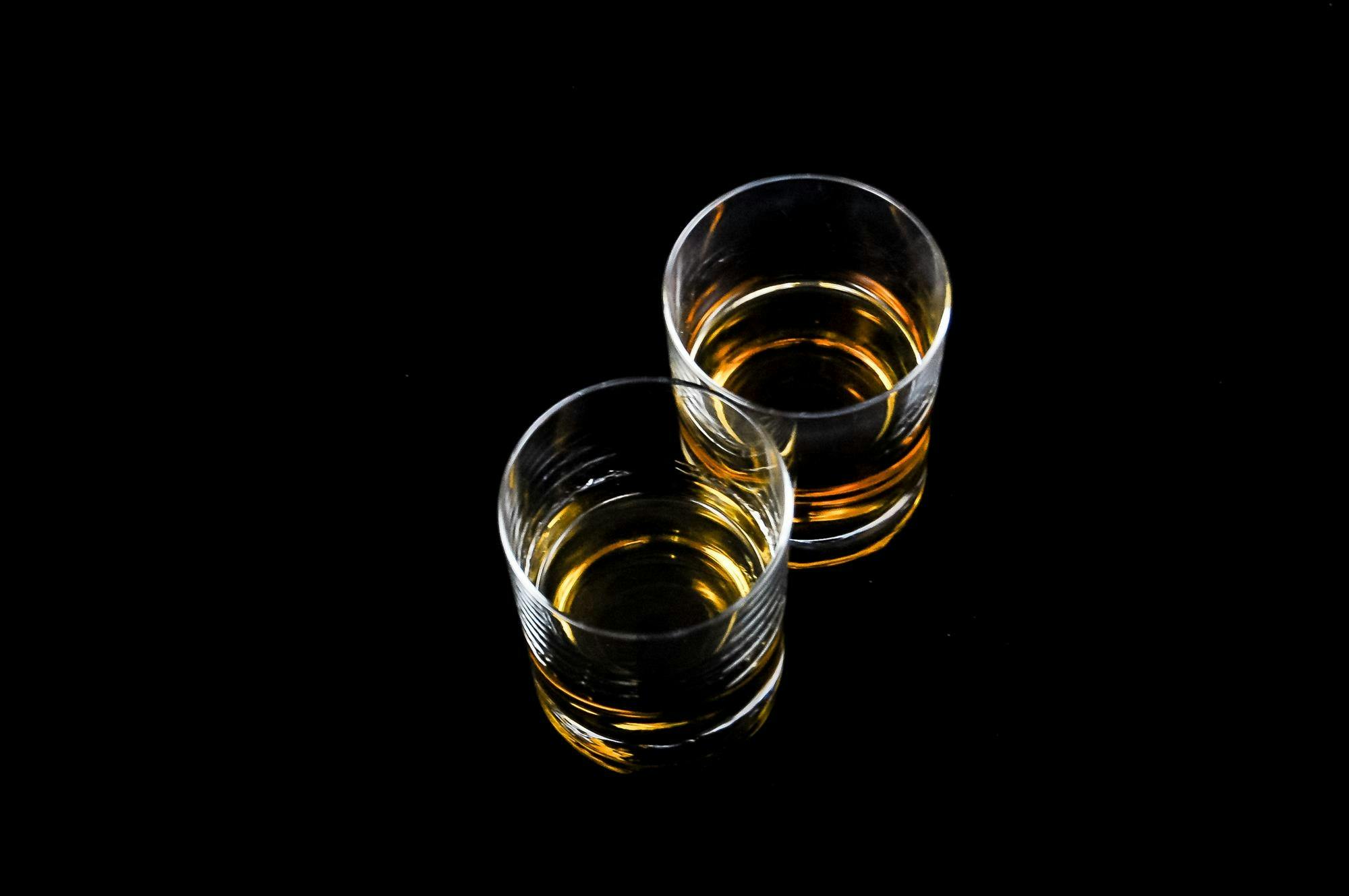
Several types of glasses coexist. The tumbler or Old Fashioned glass — wide and sturdy, popularized by cinema — is suitable for cocktails and serving on ice, but allows aromas to evaporate quickly. The tulip glass, wider at the base and narrower at the rim, concentrates aromas and appeals to the most demanding connoisseurs. The nosing glass, with a longer stem, prevents the heat of the hand from warming the liquid too quickly.
- Crystal or hand-blown glass: transparency that enhances the color of the whisky
- Narrowed rim shape: concentration of aromas for olfactory analysis
- Ergonomic grip: comfort for prolonged tasting
At Gustave Montclair, our Grenade, Damier, Floral, and Origami models combine aesthetic demand with true tasting functionality.
The whisky decanter: between aeration and elegance
Unlike wine, whisky technically doesn't need aeration — its aromatic profile evolves very little with brief contact with air. However, decanting remains interesting for practical and aesthetic reasons: elegant presentation at the table, discreetly concealed label, and sometimes a slight aromatic opening after a few minutes.
A whisky decanter like the Vintage, made of crystal, adds a decorative dimension to any level of service — even for a bottle under €30.
The whisky gift set: the ideal gift idea
A whisky gift set brings together the essentials for a complete tasting: matching glasses, decanter, sometimes whisky stones to maintain temperature without diluting the liquid. Ideal for Father's Day, a birthday, or any special occasion, our Signature and Nocturne collections offer an elegant case that enhances the gift.
To go further, also discover our sommelier gift sets and our complete whisky sets, or find our advice on how to choose your wine glass if you also host wine lovers.
How to properly serve a good and affordable whisky
The service changes the experience as much as the choice of the bottle itself. Here's how to serve an accessible whisky so that it performs at its best, from the first glass to the last.
The ideal serving temperature
Whisky is ideally enjoyed at room temperature, between 18 and 20 °C (64-68 °F). Too cold, it loses part of its aromatic palette; too warm, the alcohol dominates and masks finer nuances. Take the bottle out of the bar or cabinet about twenty minutes before serving if the room is air-conditioned.
Ice cubes, water, or neat: what to choose
Three ways to serve, three different experiences:
- Neat — the best option to fully evaluate the aromas of an accessible blend or bourbon
- With a few drops of water — releases aromatic compounds without excessive dilution, particularly useful for expressions at 43-46% ABV
- On the rocks — cools and softens, a very good option for aperitifs or summer evenings, but it closes off some of the bouquet
There is no wrong answer: the "perfect" service depends above all on the moment and the occasion, not on a fixed rule.
The right glass for a successful service
Serving a good and affordable whisky in a suitable glass immediately changes the guest's perception: the nose opens up, the color is highlighted, and the grip becomes a true tasting gesture rather than a simple reflex. Discover our selection of whisky glasses to transform every service, even for an entry-level bottle.
The decanter, to enhance even an accessible whisky
Serving from a decanter remains one of the most elegant gestures for entertaining — the bottle disappears, only the gesture and the content matter. Discover our whisky decanters for a service that honors every bottle, from the most affordable blend to the rarest single malt.
FAQ — Frequently Asked Questions about good and affordable whisky
Our accessories for serving an affordable whisky well
Expert selection by our team — Gustave Montclair catalog


Exclusive reader offer
−10% off the entire catalog
Valid on all our glasses, decanters, and accessories.


