

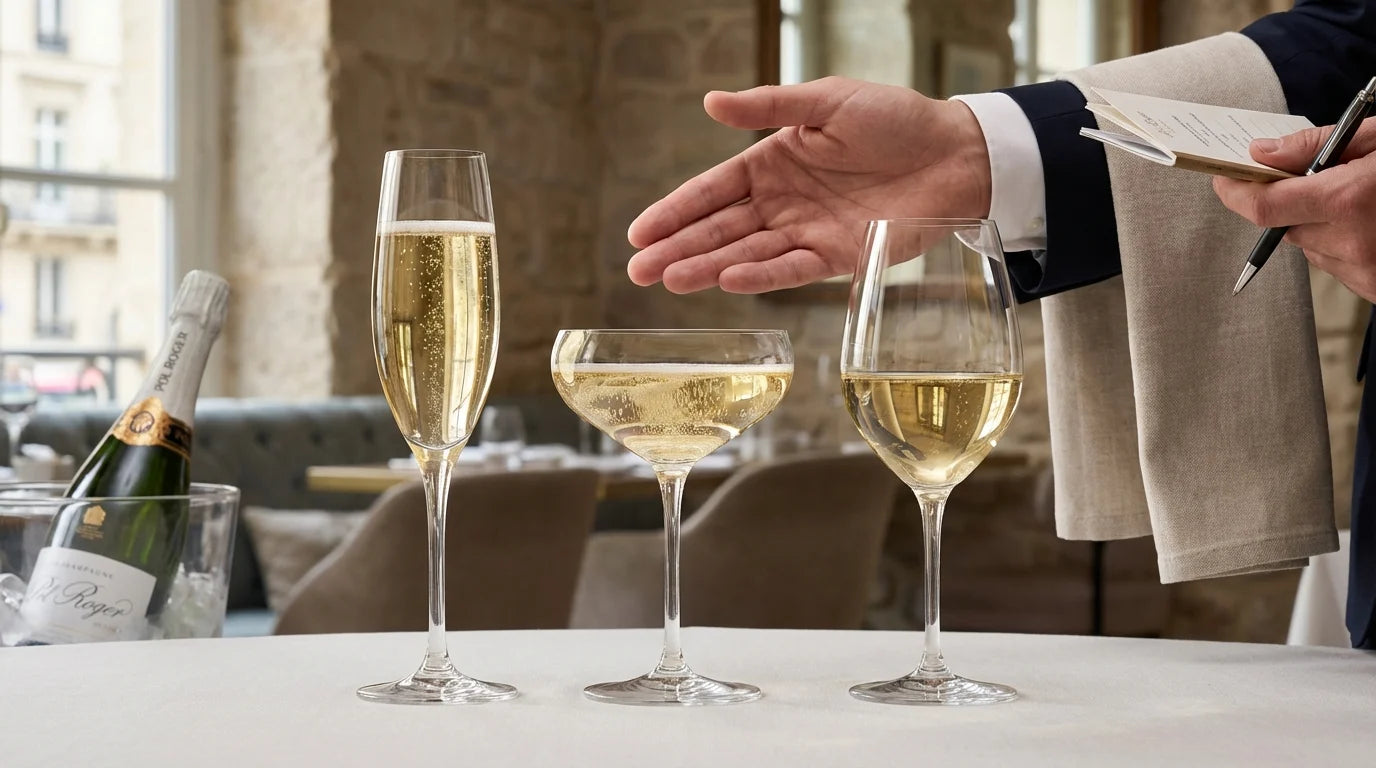
Champagne Glass: Flute, Coupe, or Tulip — Which to Choose?
The shape of the glass changes everything: discover which best reveals the aromas and preserves the effervescence of your champagne.
Opening a bottle of champagne is always an exceptional moment. Yet, even the finest vintage can be let down by an unsuitable glass. The shape of the champagne glass you choose directly influences how the bubbles rise, how the aromas are released, and how the drink presents itself on the palate. The question all enthusiasts ask, from novices to seasoned sommeliers, invariably remains the same: should one choose the champagne flute, the coupe, or the tulip glass to best reveal the qualities of your champagne?
This guide explores in detail the characteristics of each of these three formats, their respective advantages, their limitations, and the contexts in which they are indispensable. Whether you are preparing a wedding, a family reception, or simply a moment of attentive tasting, you will find here all the answers to make the best choice among the champagne glasses available.
Why the shape of the champagne glass changes everything about the tasting experience
The chemistry of champagne is remarkably complex. Resulting from a double fermentation, this sparkling wine produces carbon dioxide in the form of fine bubbles that rise in regular columns from the bottom of the glass — a phenomenon specialists refer to as nucleation. These bubbles are not just about aesthetics: they transport volatile aromatic compounds to the taster's nose, playing an essential role in the overall gustatory perception.
The shape of the glass directly determines the contact surface between the champagne and the air. A wide opening accelerates the evaporation of aromas and carbon dioxide, while a narrow opening slows this process and concentrates the scents. The height of the bowl influences the length of the bubbles' journey: the longer this journey, the larger the bubbles become before reaching the surface, changing the perceived texture in the mouth and the intensity of the aromas released.
These considerations are not anecdotal. The CIVC (Comité Champagne), the official body for the industry, has extensively documented the importance of the container on the expression of a champagne. Studies conducted by oenological institutes confirm that the perceived aromatic profile varies significantly depending on the geometry of the glass, even with identical champagne quality. In other words, serving a great champagne in a poor glass amounts to wasting part of its potential.
It should also be remembered that the cleanliness of the glass plays a decisive role. The slightest trace of detergent, limescale, or grease can inhibit nucleation and dramatically reduce effervescence. The champagne glass therefore deserves the same careful attention as the wine it welcomes. If you wish to deepen your understanding of tasting accessories, our guide on how to choose your wine glass will provide additional keys to understanding the influence of glass shapes on all types of wines.
Finally, the material of the glass also comes into play. Fine, transparent crystal better reveals the golden or rosé reflections of champagne, and its thinner wall allows for better heat transfer from the hand to the drink — a factor to consider for prolonged tastings. Our article on crystal carafe versus glass carafe explores this debate in depth.
The champagne flute — classic elegance and bubble preservation
The champagne flute is, without a doubt, the most emblematic and widespread form in the collective imagination. Recognizable by its long and narrow bowl, it established itself during the 20th century as the very symbol of celebration: from grand receptions to gala evenings, and including formal wedding toasts. Its popularity is primarily explained by its proven physical properties.
Thanks to its small exposed surface, bubbles remain active longer and champagne retains its effervescence throughout the serving. The ascent of bubbles in fine, regular columns is magnified by the transparency of the glass and the height of the bowl, creating a particularly appreciated visual spectacle during ceremonies. The flute is perfectly suited for non-vintage brut champagnes, proseccos, and fruity sparkling wines, where freshness and liveliness take precedence over aromatic complexity.
However, the flute presents a significant limitation in the eyes of tasting experts: its small opening reduces the evaporation surface, which also limits the diffusion of aromas. Floral notes, fruity nuances, and the complexity of great champagnes struggle to fully unfold in this narrow format. By concentrating bubbles in a confined space, the flute can even accentuate acidic notes and reduce the perception of toasted or biscuit notes that characterize long-aged champagnes.
For everyday quality champagne or in a festive context where effervescence and presentation take precedence over aromatic analysis, the champagne flute remains the safest and most elegant choice. It naturally integrates into refined tableware and readily accompanies a sommelier set offered as a gift. If the flute is your primary choice, consider choosing a model with a thin stem to ensure that hand warmth does not prematurely warm the champagne.
When to choose the flute?
The champagne flute is a natural choice for large receptions where rapid service for many guests is a priority. It is also the ideal choice for wedding cocktails, festive aperitifs, official toasts, and all occasions where the aesthetics of the service take precedence over detailed analysis of the content. Its relative solidity and easy handling make it a practical glass for outdoor events or standing buffets.
The champagne coupe — vintage charm, controlled use
The champagne coupe is the oldest form among the three main families. Its rounded, shallow bowl, with a wide opening, was in vogue in European royal courts in the 17th century before enjoying a second wave of popularity in the 1920s and 1930s, associated with the festive excesses of the interwar period and Art Deco aesthetics. Even today, the coupe immediately evokes a certain idea of retro glamour and timeless celebration.
Its profile offers several advantages in very specific contexts. Easy to hold, stable to place on a tray, and quickly filled, it is particularly appreciated for champagne towers that decorate buffets and bars at large events. Its wide opening also facilitates the addition of garnishes or fruits for festive cocktails based on champagne, crémant, or sparkling wine. For recipes that combine effervescence with fruit syrups or liqueurs, the coupe adapts better than the flute.
However, from a pure tasting perspective, the coupe has major drawbacks that enlightened amateurs cannot ignore. The large exposed surface leads to rapid CO₂ evaporation: bubbles disappear in a few minutes, and the champagne warms up faster upon contact with air. Aromas, unable to concentrate in a confined space, immediately disperse into the atmosphere. The result: a great vintage champagne served in a coupe loses a large part of its aromatic complexity and freshness in less than ten minutes.

The coupe therefore remains perfectly suited for cocktails made with champagne, retro-themed evenings, or decorative displays. For enthusiasts who wish to vary their pleasures and have a complete range of glasses, it ideally complements a champagne glass assortment without claiming to replace it. If you also like to diversify your pleasures beyond champagne, our cocktail glasses offer many shapes adapted to all your mixology creations.
The tulip glass — the choice of sommeliers and champagne houses
The tulip glass now represents the absolute benchmark for sommeliers, oenologists, and all those who wish to appreciate champagne in the best possible conditions. Its shape is particularly well thought out: a relatively wide body allows aromas to develop and accumulate, while a slight curve or narrowing of the opening effectively channels these aromas towards the taster's nose. This dual advantage — aromatic expression and preservation of effervescence — makes the tulip the most versatile and complete format.
Unlike the flute, the tulip glass offers enough space for the complex aromas of champagnes to fully reveal themselves. Notes of brioche, hazelnut, white-fleshed fruits, and citrus characteristic of prestige champagnes or old vines express themselves much better than in a narrow glass. At the same time, its height and the slight curve of its rim help maintain active bubbles significantly longer than a coupe, while offering a much larger surface for expression than a classic flute.
Major Champagne Houses and professional industry bodies have progressively adopted the tulip glass for their official tastings. The Union des Maisons de Champagne and the CIVC recommend this format to allow a complete reading of a champagne's characteristics: the color, the persistent mousse, the primary, secondary, and tertiary aromas, the bubble, the attack on the palate, and the length of the finish.
It is suitable for non-vintage brut champagnes as well as prestige cuvées, rosés as well as blancs de blancs, demi-secs as well as extra-bruts. Its versatility makes it the most judicious investment for anyone wishing to have a single champagne glass capable of adapting to all styles and occasions. It is also a safe bet for a gift to a wine lover, paired for example with a beautiful wine decanter for a complete tasting experience.
The tulip glass for prestige champagnes
If you invest in exceptional bottles — old vintages, special cuvées, Grand Cru blancs de blancs — the tulip glass is absolutely essential. Its ability to reveal the aromatic complexity of these wines alone justifies the investment in a beautiful set of tulip glasses. Many enthusiasts have discovered unsuspected facets of their favorite champagnes simply by changing the glass format.
Comparative table: flute, coupe, and tulip glass side by side
To facilitate your decision, here is a summary table comparing the three formats according to the essential criteria of tasting and practical use. Each format has its legitimacy depending on the context: the goal is not to designate a single winner, but to help you choose the right tool for each situation.
| Format | Bubble Preservation | Aroma Expression | Ideal Use | Profile |
|---|---|---|---|---|
| Champagne Flute | ★★★★★ | ★★★☆☆ | Receptions, weddings, festive service | Elegant · Classic |
| Champagne Coupe | ★★☆☆☆ | ★★☆☆☆ | Cocktails, decoration, retro ambiance | Vintage · Festive |
| Tulip Glass Recommended | ★★★★☆ | ★★★★★ | Tasting, grand champagnes, experts | Expert · Versatile |
In practice, the choices are not necessarily exclusive. Many enthusiasts own both flutes for grand occasions and tulip glasses for more attentive tastings. If you had to choose only one format, the tulip glass offers the best balance between versatility, aromatic performance, and compatibility with most champagne styles.
The criterion of capacity
Regardless of the chosen format, the optimal capacity of a champagne glass is between 150 and 300 ml. This range allows for serving a standard pour (about 100 to 120 ml) while leaving enough space above the liquid for aromas to develop and concentrate before reaching the nose. A glass that is too small requires filling it too high, which accelerates the loss of aromas and effervescence. A glass that is too large visually dilutes the precious string of bubbles and makes the tasting look untidy.
Maintenance, an often overlooked factor
The quality of washing directly conditions the quality of the tasting. Detergent residues disturb nucleation and can create off-flavors in the glass. Limescale traces prevent bubbles from forming regularly. It is advisable to wash champagne glasses with warm water and a mild, unscented product, rinse them thoroughly, and immediately dry them with a clean, dry microfiber cloth. Stored vertically and away from ambient odors, they will be ready to magnify your next champagne. If you are also looking to enhance your still wines, consult our selection of wine glasses to complete your service.

Our selection of champagne glasses for every occasion
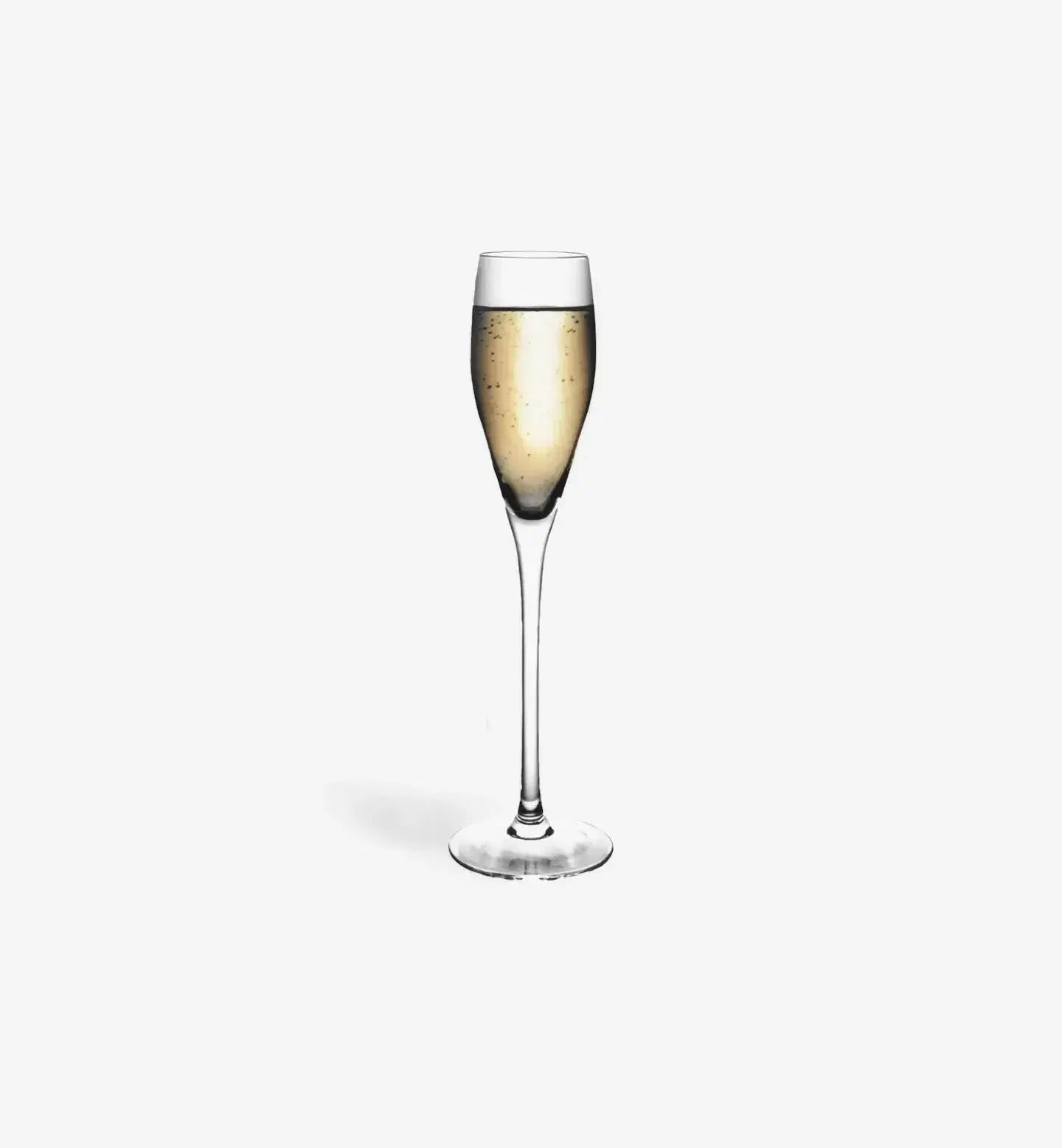
At Gustave Montclair, we have designed a range of champagne flutes that combine tasting quality with visual refinement. Whether you are looking for a classic model for a wedding, a contemporary design for a modern reception, or a technical glass to appreciate great vintages, our catalog offers options suited to every user profile and every budget. Each model is selected for its ability to preserve bubbles, optical clarity, and ergonomics.

If you wish to give a memorable gift to a champagne lover or complement your own table setting, consider pairing it with other complementary accessories. A sommelier set with a corkscrew, cooling ring, and cellar thermometer makes a perfect gift for holidays, birthdays, or weddings. Our guide on why and how to decant wine also provides useful insights to enrich your tasting practice. And if you wish to offer sparkling cocktails at your receptions, our cocktail kits will be your best allies to surprise your guests.
FAQ — Frequently Asked Questions about Champagne Glasses
Our selection of champagne glasses
Expertly selected by our team — Gustave Montclair catalog


Exclusive reader offer
−10% off the entire catalog
Valid on all our glasses, carafes, and accessories.
Sources
- CIVC — Comité Champagne — champagne.fr — 2025
- Union des Maisons de Champagne — maisons-champagne.com — 2025
- OIV — Organisation Internationale de la Vigne et du Vin — oiv.int — 2024


