


Wine Decanter – Cleaning and Maintenance to Preserve its Brilliance
Coarse salt, baking soda, white vinegar, or stainless steel beads: the right method for each type of residue to restore your decanter's sparkle.
A wine decanter is much more than a simple container: it is a precise oenological tool, an object of elegance that enhances your bottles and reveals the aromatic complexity of your wines. Whether it's a blown glass decanter or a bevelled crystal piece, each decanter deserves appropriate care to maintain its brilliance throughout its life.
Tannin residues, limescale deposits, moisture marks: these are all impurities that discreetly accumulate and can, in the long run, alter the quality of your next tastings. In this guide, the Gustave Montclair team details, method by method, how to effectively clean a wine decanter — even when its complex design makes the task delicate — and then how to dry it, store it, and care for the rest of your glassware with the same attention.
Why is it important to maintain your wine decanter?
Preserving the purity of aromas
The primary reason to rigorously clean a wine decanter after each use is primarily for taste. Red wine leaves residues of tannins, anthocyanin pigments, and tartaric acids on the glass walls which, if not promptly removed, create an invisible biofilm. During the next serving, this film can release parasitic aromas that cloud the nuances of the carefully selected vintage. To understand the oxygenation phenomena that justify the use of a decanter, our article on wine decantation and aeration provides a comprehensive explanation.
Maintaining the glass's shine and brilliance
At Gustave Montclair, our wine decanters are designed from high-quality blown glass, selected for its transparency and light refraction. Proper, hand-washing, non-abrasive care ensures this brilliance lasts over time. Limescale from tap water, left to dry on the walls, creates milky veils particularly visible on clear glass — an aesthetic flaw that can also, with prolonged contact, very slightly alter the taste of water or wine.
Extending the lifespan of your accessory
Regular and gentle maintenance structurally protects the decanter: violent washing in a high-temperature dishwasher gradually weakens the glass, leading to micro-cracks and irreversible cloudiness. The simplest gesture is also the most protective — an immediate rinse with lukewarm water after each serving prevents tannins from drying on the walls, a stage from which deposits become significantly harder to remove. If you are still hesitating between glass and crystal for your next purchase, our comparison crystal decanter vs. glass decanter will guide you.
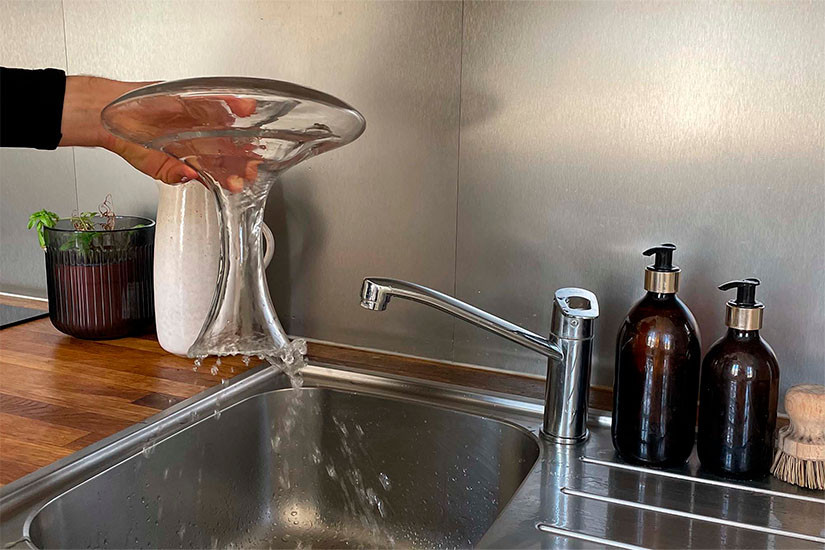
Cleaning a wine decanter with coarse salt: the most effective method against tannins
Why coarse salt works so well
For stubborn red wine residues, the coarse salt method is the oldest and most recommended by sommeliers. Salt grains, harder than glass is fragile, act as a natural abrasive: they gradually dislodge deposits encrusted on curved walls, without ever scratching the surface. This is the reference technique for cleaning a wine decanter after a generous serving, especially on decanters with a wide base, where deposits accumulate first.
Step-by-step instructions
- Pour a generous handful of non-iodized coarse salt into the decanter.
- Add a little lukewarm water, just enough for the salt to move freely.
- Hold the decanter by the neck or base and swirl gently for two to three minutes.
- Rinse thoroughly with lukewarm water until all salt has disappeared.
Cleaning a wine decanter with baking soda: gentle and effective
When to prefer baking soda to coarse salt
Baking soda is the ideal ally for the regular maintenance of a wine decanter, especially when a slight haze or cloudiness appears after several months of use. Its slightly alkaline nature neutralizes organic acids left by the wine, while acting as a gentle stain remover suitable for both blown glass and crystal models, without ever altering the glass's transparency.
Dosage, soaking time, and rinsing
To clean a wine decanter with baking soda, dissolve a tablespoon of baking soda in lukewarm water, pour this mixture into the decanter, and let it sit for about twenty minutes. Gently swirl the liquid halfway through so it reaches all the walls, then rinse thoroughly with clean water. This gentle method is also the recommended solution in case of a persistent odor: a teaspoon of baking soda left overnight is usually enough to eliminate it.
Cleaning a wine decanter with white vinegar: the ultimate anti-limescale solution
Recognizing a limescale deposit
A whitish film that persists after a classic rinse, concentrated near the usual water line, indicates a limescale deposit rather than tannin residue. This is the result of highly calcified water left to dry on the walls. For this type of deposit, diluted white vinegar is the most effective method — much more so than coarse salt or baking soda, which primarily act on tannins.
The dilution that works, without damaging the glass
Mix one part white vinegar to two parts lukewarm water, pour into the decanter and let it sit for thirty minutes to an hour depending on the extent of the deposit. Then rinse repeatedly with clean water to eliminate any acidic odor; if it persists, a final rinse with slightly lemon water will completely neutralize it. However, avoid concentrated acidic household detergents, whose chemical formulations can attack the surface treatments of premium glasses.
Cleaning a wine decanter with stainless steel beads: the solution for complex designs
For which decanter models should you opt for beads
Some models — with very narrow necks, flared bases, or intricate geometric shapes — make internal access particularly difficult for a hand or a classic brush. For these cases, stainless steel cleaning beads are an ingenious solution: endlessly reusable, they adapt to all internal geometries without ever scratching the glass.
The right technique, without forcing
Introduce the beads into the decanter with a little lukewarm water, then gently swirl by hand: each rotation gently rubs the walls and dislodges tannins and deposits without excessive pressure. Two to three minutes of continuous rotation are usually sufficient. Then rinse thoroughly and let the beads dry separately before storing them.
| Method | Wine deposit effectiveness | Anti-limescale | Ideal for |
|---|---|---|---|
| Warm water alone | ★★★☆☆ | ★★☆☆☆ | Immediate daily rinse |
| Coarse salt + water | ★★★★★ | ★★☆☆☆ | Stubborn tannin deposits |
| Baking soda | ★★★★☆ | ★★★☆☆ | Weekly maintenance, odors |
| White vinegar | ★★☆☆☆ | ★★★★★ | White limescale deposits |
| Stainless steel beads | ★★★★☆ | ★★★☆☆ | Narrow-necked designs |
Drying, storage, and odor prevention
Drying your wine decanter without leaving streaks
The drying phase is often overlooked, yet it is crucial for final cleanliness. A rinsed but poorly dried decanter will inevitably show rings or water spots. The most effective method is to turn the decanter upside down on a suitable stand — a specialized decanter dryer is ideal — and allow air to circulate freely for at least two hours.
For crystal models, avoid any fabric contact with the inner walls: the microfibers of ordinary cloths leave invisible but perceptible fibers. If you want to speed up drying, gently slide an extra-long microfiber cloth inside, without rubbing.
Preventing musty odors
A decanter left stoppered or stored in a closed space without being perfectly dry will quickly develop musty or moldy odors. Always store it open, neck up, in a well-ventilated area away from direct light. If an odor persists despite these precautions, the baking soda method described above comes to the rescue again.
Optimal storage and preservation
Between uses, the wine decanter deserves a prominent place in your home — for practical as well as aesthetic reasons. A sideboard or shelf dedicated to your glassware, with your wine glasses and any sommelier kits, creates a tasting space always ready to receive.
- Avoid closed packaging boxes and damp cupboards.
- For long-term storage, slip a small sachet of silica gel inside.
- Never store two decanters stacked or in direct contact with a hard object.
Caring for your wine glasses and whiskey glasses
The right gestures for your wine glasses
Wine glasses share the same care requirements as the decanter: hand wash in lukewarm water, without scented detergent. Always hold your glass by the base, never by the stem, to avoid any twisting that could weaken it. Dry immediately with a clean microfiber cloth, using gentle circular motions from the outside. To delve deeper into choosing a model adapted to each grape variety, our guide how to choose your wine glass details the essential criteria. Also discover our collection of tasting glasses, designed to enhance each grape variety.
The right gestures for your whiskey glasses
Whiskey glasses have a peculiarity: their often thick base and decorative engravings are preferential accumulation zones for spirit residues, rich in sugars and alcohol. Rinse them after each tasting with lukewarm water without soap, insisting on the engraved areas with a soft brush if necessary, and let them dry upside down. Discover our whiskey glasses in lead-free crystal. And to master the art of serving before decanting, our article how to decant red wine will give you all the keys.
FAQ — Frequently Asked Questions about cleaning a wine decanter
Sources
- OIV — International Organisation of Vine and Wine, International Compendium of Methods of Wine Analysis — oiv.int, 2024
- BIVB — Burgundy Wine Board, Guide to Wine Service and Tasting — bivb.com, 2023
- Union de la Sommellerie Française, Professional recommendations for the maintenance of oenological glassware — sommellerie-internationale.com, 2023
Our Wine Decanters — For Easy Daily Maintenance
Expert selection by our team — Gustave Montclair catalog


Exclusive reader offer
−10% off the entire catalog
Valid on all our glasses, carafes, and accessories.


