

Decanting a white wine: what it really means
First and foremost, let's define the terms correctly. Decanting involves transferring wine into a vessel with a large surface area for contact with air, to intentionally oxygenate it. The goal is to artificially accelerate aromatic development: we seek to open a wine that would otherwise be closed, austere, or marked by flaws related to lack of aeration.
This is not the same operation as racking, which aims to separate an old wine from its sediment while minimizing contact with oxygen. Both actions involve a decanter, but their objectives are diametrically opposed – one seeks air, the other avoids it.
Decanting vs. Racking: two actions with different goals
For white wine, we almost always speak of decanting. Racking a white wine is rare and only concerns very old vintages that may have developed tartrate deposits, which is exceptional. In the vast majority of situations you encounter daily, if you take a white wine from the cellar and consider pouring it into a decanter, it is indeed to aerate it.
The question then is simple: does this wine need to open up? And in the case of white wine, the answer is never obvious a priori. It depends on the grape variety, the appellation, the aging method, and the vintage.
What happens chemically in the decanter
When a white wine comes into contact with air's oxygen, several reactions occur simultaneously. Volatile sulfur compounds — primarily responsible for unpleasant reductive odors (struck match, rubber) — evaporate quickly. Aromatic esters express themselves more freely. Tertiary aromas of a wine aged in oak barrels — vanilla, toast, melted butter — gain in breadth and harmony.
However, if this oxygenation continues for too long, it becomes harmful oxidation: fruity and floral aromas fade, the wine loses freshness and tension. This is why decanting a white wine must always be short and controlled, never more than 20 to 30 minutes in the fullest-bodied cases. To understand how to choose the right container for this action, consult our comparison crystal or blown glass for your decanter.
White wines that benefit from decanting
There's a simple rule of thumb for identifying candidates for decanting: the richer, fuller, more complex, and wood-aged a white wine is, the more likely it is to benefit from a brief aeration. Conversely, lightness and aromatic vibrancy are signals that should encourage caution.
Great white wines from Burgundy and the Rhône
This is where white wine decanting finds its natural territory. Great Burgundian Chardonnays – Meursault, Puligny-Montrachet, Chassagne-Montrachet, Chablis Premier and Grand Cru – are wines of such richness and complexity that they often deserve a few minutes of aeration, especially when they are still young. Their partial or total aging in oak barrels gives them a structure that fully reveals itself on contact with air.
The great white appellations of the Northern Rhône – Hermitage blanc, Saint-Joseph blanc, Condrieu made from Viognier – respond very well to the same treatment. Their intense aromatic profile, with notes of white peach and ripe apricot, open up spectacularly after about fifteen minutes in a decanter. This is also true for Châteauneuf-du-Pape blanc, often a complex blend dominated by Clairette and Grenache blanc.
Experts from Dijon Capitale point out that decanting young white and red Burgundy wines for a few minutes before serving is increasingly practiced to allow them to better reveal the richness and complexity of their aromas. The condition remains the same – taste first, then decant.
The particular case of reductive wines
Reduction is an aeration defect that manifests at the opening of a bottle with unpleasant odors: struck match, burnt rubber, or even sulphurous notes. It is not necessarily a sign of a bad wine – many great wines go through reductive phases related to their aging method or storage.
In this specific case, the decanter is not only useful but often essential. A white wine showing reduction should be decanted somewhat vigorously, pouring it in a thin stream from a height to maximize contact with air. In 10 to 15 minutes, the volatile sulfur compounds evaporate, and the wine regains its full aromatic expressiveness.
Before decanting your white, pour 3 cl into a glass and wait 2 minutes. If the aromas open up and become more expressive after agitation, decanting is necessary. If the wine is already open and fruity, serve it directly — you'll gain freshness.
Natural and Biodynamic Wines
Natural wines, vinified with little or no added sulfur, are particularly prone to reductive phases. The absence of sulfites as a protective agent exposes the wine more to sometimes unstable aromatic developments. These white wines are often very good candidates for decanting, sometimes even for a slightly longer duration than conventional whites — 20 to 30 minutes in some cases. Wine decanters with a wide base offer an advantage here: their large aeration surface allows for a quick and homogeneous aromatic awakening.

White wines never to decant
While the list of white wines that benefit from decanting is real, it is also a minority compared to the overall global production. The vast majority of white wines you open daily neither need nor benefit from decanting – on the contrary, it could risk damaging them.
Light, aromatic, and fruity whites
Wines designed for freshness and immediate aromatic expression should be served directly from the bottle. Oxygenating them, even briefly, would erase their main assets:
- Young Sauvignon Blanc (Sancerre, Pouilly-Fumé, Loire wines in general): their distinctive vegetal and citrus notes evaporate on contact with air.
- Dry Alsace Riesling: the mineral tension and lively acidity that make them charming quickly diminish.
- Pinot Blanc, light Pinot Gris: too delicate to withstand oxygenation.
- Muscadet, Picpoul, Vermentino: to be drunk chilled and young, always directly from the bottle.
- Light and uncomplicated summer white wines: their only appeal is their freshness, which a decanter would only compromise.
The rule of thumb: if your white wine is usually drunk young (less than 3 to 4 years old) and appreciated for its lightness and fresh aromas, avoid the decanter. To properly accompany these wines, choosing the right glass will be much more crucial than any decanting.
The absolute rule: never sparkling wines
This point is unambiguous and tolerates no exceptions. You should never decant a sparkling wine – Champagne, Crémant, Prosecco, Cava, or natural sparkling wine. Pouring a sparkling wine into a decanter immediately destroys its CO₂ pressure and, with it, all its effervescence. You will end up with a flat, lifeless wine that has lost the essence of its identity. Always serve bubbles directly from the bottle, in suitable Champagne flutes that preserve the rise of the bubbles.
| Type of White Wine | Decant? | Recommended Duration | Key Remark |
|---|---|---|---|
| Meursault, Puligny-Montrachet | ✓ Yes | 15 – 20 min | Ideal for vintages 2 to 8 years old |
| Chablis Premier & Grand Cru | ✓ Yes | 10 – 15 min | Reveals minerality and reduces reduction |
| Hermitage blanc, Condrieu | ✓ Yes | 15 – 25 min | Wide base recommended |
| Châteauneuf-du-Pape blanc | ✓ Yes | 15 – 20 min | Bucket of fresh water essential in summer |
| Reductive white wine | ✓ Yes | 10 – 15 min | Pour vigorously to evaporate sulfur |
| Natural wine, low sulfite | ⚡ Depending on condition | 10 – 30 min | Taste first: if open, avoid decanting |
| Young Sancerre, Pouilly-Fumé | ✗ No | — | Aromatic freshness evaporates |
| Dry Alsace Riesling | ✗ No | — | Minerality and tension are lost |
| Muscadet, Picpoul, Vermentino | ✗ No | — | Fresh wines to serve cold, direct |
| Champagne, Crémant, Prosecco | ✗ Never | — | Immediate destruction of effervescence |
How long should a white wine be decanted?
This is the most practical question — and the one that most clearly differentiates decanting a white wine from a red. Where a young Bordeaux can remain 90 minutes to 2 hours in an oenological accessory without risk, a white wine never tolerates such a long aeration.
The durations to respect depend above all on the wine's profile:
- Full-bodied white aged in barrel (Meursault, Hermitage): 15 to 20 minutes — this is the maximum not to exceed.
- White wine with slight reduction: 10 to 15 minutes are generally enough to dissipate the sulfur compounds.
- Complex natural wine: up to 20 to 30 minutes in the most closed cases, but monitoring aromatic evolution.
- Young and mineral Chablis Premier Cru: 10 to 12 minutes — just enough to open the aromas without destroying the tension.
In all cases, the best method is to taste every 5 minutes. As soon as the wine fully expresses its aromas and the palate reveals balance and length, serve immediately.
In summer, a decanter placed on a table at 25 to 30 °C will warm a white wine in just a few minutes. Always place your decanter in a bucket of cold or lightly iced water for the entire aeration period. This maintains the serving temperature between 10 and 12 °C and preserves the wine's freshness.
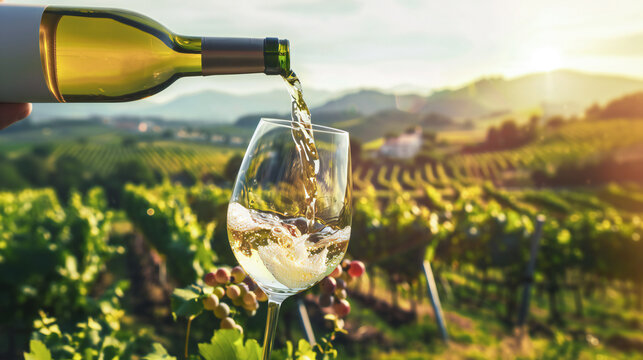
How to decant a white wine in practice
The technique for decanting a white wine is slightly different from that for a red, as the objectives are not quite the same. For a young, tannic red, vigorous and prolonged oxygenation is sought. For a white, the aim is gentle, controlled, and brief aeration.
Taste First, Decide Later
This step is fundamental and often overlooked. Open the bottle and pour a small amount into a glass. Swirl the glass, smell it at length, then taste. If the wine is already open, expressive, and balanced on the palate, do not decant it — there is nothing to gain. If, on the other hand, it shows sulfur notes, a tight and unaromatic palate, or if the aromas open up significantly after swirling the glass, decanting is in order.
The Gentle Pouring Technique
Unlike red wine, do not pour white wine in a brutal stream. Hold the decanter slightly tilted and let the wine flow along the inner wall. This gesture allows for gradual aeration without thermal shock or brutal oxidation. If the wine is slightly reduced, you can pour from a height of 20 to 30 cm to accelerate the evaporation of sulfur compounds — but only in this case.
Once the wine is transferred, never close the decanter with a stopper during the aeration phase. Leave it open, exposed to the air. You can gently swirl the wine in the decanter once or twice to amplify the exchange with oxygen if the progression seems too slow.
Maintain Freshness: The Water Bucket, a Summer Ally
Outside of the winter months, temperature is the number one enemy of white wine in a decanter. A decanter at summer room temperature can warm a white wine by 6 to 8 °C in less than 15 minutes, taking it from an ideal serving temperature to a flabby, heavy palate. Prepare a bucket of cold water — not necessarily iced, which could numb the aromas — and place the decanter in it for the entire aeration period. If you don't have a bucket, at least place the decanter in the refrigerator 5 minutes before serving.
What Decanter Shape for White Wine?
The shape of the decanter plays a practical role. For white wine, a decanter with a moderately wide base and a relatively narrow neck is preferred — unlike a duck-shaped decanter with a wide flared neck, which would be better suited for a very young red requiring maximum oxygenation. A wide base is sufficient to create an effective aeration surface, while a narrower neck slows down the evaporation of volatile aromas and freshness molecules. Our collection of wine decanters offers several suitable shapes, including the Orphée rotating decanter, whose 360° base allows for gentle and progressive aeration, ideal for complex whites. To delve deeper into the topic of choosing a suitable wine glass to accompany the service, our experts have written a comprehensive guide.
If you are hesitant to invest in a specific decanter for white wine, know that a versatile 1 to 1.5 L wine decanter will do very well for most situations. The essential thing is that the bottom is wider than the neck, and that the decanter is made of clear glass to appreciate the wine's color. To further equip yourself, a sommelier set can also usefully complement your home bar.
FAQ — Frequently Asked Questions about Decanting White Wine
Our Selection of Wine Decanters
Expert selection by our team — Gustave Montclair catalog


