


Decanter Carafe: How to Choose the Best Wine Decanter in 2026
Oxygenation, materials, shapes, decanting time — everything you need to know to choose the ideal carafe according to your tasting style.
Decanting is one of the simplest and most transformative gestures in the art of tasting. Slowly pouring your wine into a decanter carafe, watching the liquid blossom and release its first aromas, then serving a bottle whose personality is fully revealed: each step provides immediate satisfaction that wine lovers immediately recognize. However, not all carafes are created equal, and choosing a good wine decanter can make the difference between an ordinary tasting and a memorable experience.
At Gustave Montclair, our range of wine decanters has been designed with three imperatives in mind: optimal oxygenation regardless of the model's shape, an aesthetic that effortlessly graces your table, and manufacturing quality designed to last. In this comprehensive guide, we explain why and how to decant your wine, the essential criteria for identifying your ideal model, and we present in detail the five most popular decanter carafes from our catalog. Whether you are looking for a rotating model for special occasions, a sleek carafe for daily use, or an exceptional oenophile gift, you will find all the information here to make an informed choice.

Why use a decanter carafe?
The short answer: because the vast majority of red wines — and even some powerful whites or structured rosés — express themselves much better after decanting. The long answer requires understanding two distinct phenomena that are often confused: oxygenation and sediment separation. These two mechanisms alone justify the investment in a good wine decanter.
Oxygenation — or aeration — consists of exposing the wine to ambient air to accelerate its natural evolution. When a young red wine is bottled, it contains polymerized tannins that present to the palate as an astringent sensation, sometimes perceived as harsh or rough. In contact with oxygen, these tannins gradually soften, volatile aromatic compounds are released, and the wine opens up to reveal its layers of complexity. Fifteen to forty minutes in a well-designed decanter carafe can transform a closed and austere wine into a supple, fruity, and expressive glass. A model with a wide flat base, like our Aurora or Silver Edition carafes, maximizes the contact surface between the wine and the air, dramatically accelerating this process.
Sediment separation mainly concerns aged wines, whose tannins and other polyphenolic compounds naturally precipitate to the bottom of the bottle after several years of aging. These sediments, while completely natural and harmless, nevertheless alter the wine's texture in the mouth by giving an unpleasant grainy sensation. Carefully decanting an old vintage — by gently tilting the bottle over a light source to monitor the progress of the sediment — allows for serving a perfectly clear wine, true to its purest expression. This was also the original use of the wine decanter, before the term broadly referred to all aeration carafes.
Beyond these two primary functions, the wine decanter possesses an undeniable aesthetic and ritual dimension. Placing a beautiful carafe on the table transforms wine service into a ceremony, highlights your attention to the choice of bottle, and invites your guests to contemplate the wine even before taking a sip. This is one of the reasons why a decanter carafe is one of the most appreciated oenological accessories as a gift: it combines utility, beauty, and a strong gesture. To delve deeper into the differences between long decanting and rapid aeration, and to understand when to prefer one over the other depending on the wine's profile, our article Why decant a wine: decantation vs. aeration gives you all the answers with practical examples by grape variety and appellation.
How to choose your wine decanter
Given the diversity of models available on the market, several criteria allow us to distinguish a truly effective decanter carafe from a simple decorative object. These parameters should guide your decision before any purchase, whether for yourself or as a gift.
Capacity and base shape
A standard bottle is 75 cl, but it is advisable to choose a carafe of at least 1.5 liters to allow the wine to fully develop without being cramped. Models from 1.5 L to 1.8 L are the most versatile and suitable for almost all bottles you will decant. The shape of the base is equally crucial: the larger the contact surface between the wine and the air, the faster and more homogeneous the aeration. Carafes with a wide, flared base excel in this, while models with a more cylindrical body offer slower, more controlled aeration, ideal for grand cru wines that require a more gradual evolution.
Innovative aeration systems
Some carafes incorporate mechanisms that multiply oxygenation without additional effort. The 360° rotating base, present on our Aurora and Silver Edition models, allows you to gently swirl the wine while keeping the carafe on its stand, effortlessly and without risk of spillage. This is a particularly effective solution for very young and tannic wines, or for hosts who want to accelerate aeration during an impromptu service.
The choice of material
The carafe's material influences its appearance, durability, and the visual rendering of the wine's color. To understand precisely the differences between lead-free crystal and ordinary glass — transparency, brilliance, resonance, thermal shock resistance — our article Crystal carafe vs. glass carafe: what to choose? offers a detailed and impartial analysis. In summary, lead-free crystal offers exceptional clarity that enhances the wine's color, while borosilicate glass — used in our rotating carafes — is more resistant to temperature variations and offers increased durability for intensive daily use. Blown glass, finally, brings a finesse and lightness that highlight the model's lines, as seen on our Rays carafe.
Ergonomics and ease of maintenance
A full carafe represents a significant weight when serving. Some models, like our Veloce, incorporate a sculpted side handle that greatly facilitates pouring, even when decanting an old vintage held over a candle. The shape of the pouring spout also determines the precision of the service and minimizes drips. For maintenance, carafes with a wide neck are easier to clean than models with a narrow neck. Our guide to maintaining and cleaning a wine carafe explains the best techniques for preserving the glass's brilliance in the long term.
Comparison: Gustave Montclair's 5 best decanter carafes
To help you quickly identify the model that suits your use, here is a comparative table of our five most popular references among our wine-loving customers:
| Model | Capacity | Mechanism | Material | Ideal for |
|---|---|---|---|---|
| Silver Edition | 1.5 L | 360° Rotating | Borosilicate | Tannic wines, large gatherings |
| Éclipse | 1.5 L | Flared base, 2 spouts | Crystal | Elegant service, rich wines |
| Solen | 1.8 L | Straight neck, wide base | Glass | Versatile, daily use |
| Veloce | 1.8 L | Ergonomic handle | Glass | Easy serving, mobility |
| Rays | 1.8 L | Angled neck, wide base | Blown glass | Decoration, reds and whites |
Silver Edition Rotating Wine Decanter — the fastest oxygenation

The Silver Edition embodies the best that technology applied to tasting can produce. Its 360° rotating base with a silver finish allows you to gently swirl the wine while the carafe rests on its stand, effortlessly and without risk of tipping. This continuous circular movement constantly exposes new surfaces to ambient air, significantly accelerating aeration compared to a static carafe. Result: a Bordeaux or Syrah that is closed upon opening reveals aromas in 15 to 20 minutes that you would have waited an hour for in a classic model. Made of thermal shock-resistant borosilicate, this wine decanter can also be rinsed with cold water immediately after use, which greatly simplifies maintenance. An exceptional model, as appealing in use as it is for decoration.
Éclipse Wine Decanter — crystal serving elegance

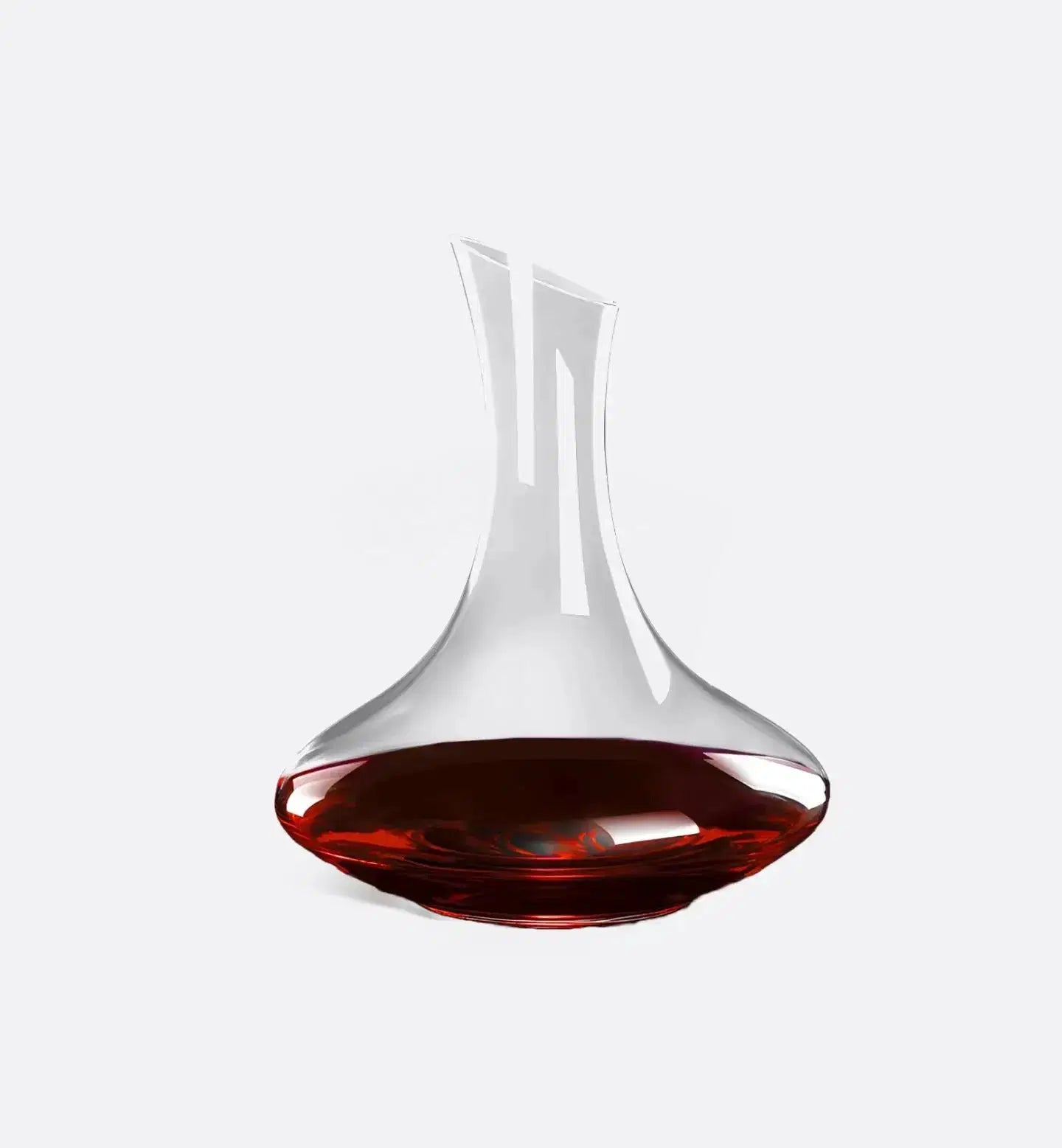
The Éclipse immediately stands out with its luminous oval shape and its two offset spouts, a recognizable visual signature among all. Designed in lead-free crystal of spectacular transparency, this decanter carafe captures and diffuses light in a way that enhances every nuance of the wine's color. Functionally, its wide, flared base ensures homogeneous and effective aeration, particularly suitable for red wines rich in character such as great Côtes-du-Rhône, Châteauneuf-du-Pape, or Languedoc wines. The Éclipse is the carafe you place on the table that invariably elicits comments from guests even before the wine is served. An ideal oenophile gift for lovers of beautiful things.
Solen Wine Decanter — everyday versatility

The Solen is the very definition of elegance through simplicity. Its pure lines, soft curves, and slightly flared neck make it a universal wine decanter, capable of accompanying both a powerful red wine and a generous white. With its 1.8 L capacity, it comfortably accommodates an entire bottle with enough space for the wine to breathe freely. The smooth and perfectly transparent glass enhances the color without visual interference, making it an excellent choice for presenting your most beautiful bottles at the table. The Solen is the everyday carafe that never disappoints, the one you bring out without hesitation for an impromptu dinner or a carefully prepared meal. Its ease of maintenance and durability make it our recommendation for enthusiasts who want to start with a quality carafe without compromise.
Veloce Wine Decanter — ergonomics reinvented

The Veloce solves a problem that every wine lover has encountered at least once: how to pour precisely from a full carafe without risking spilling the wine or tiring your wrist? Its sculpted side handle integrated into the body of the glass provides a definitive answer to this question. Ergonomic, stable, and with a natural grip, the Veloce transforms serving into a fluid and assured gesture, even with a 1.8 L carafe filled to the brim. This model is particularly appreciated by hosts who decant frequently, restaurateurs, and anyone who appreciates that functionality and design are never at odds. The precise pouring spout minimizes drips, and its internal geometry ensures balanced oxygenation comparable to any model in a similar range.
Rays Wine Decanter — the art of tasting

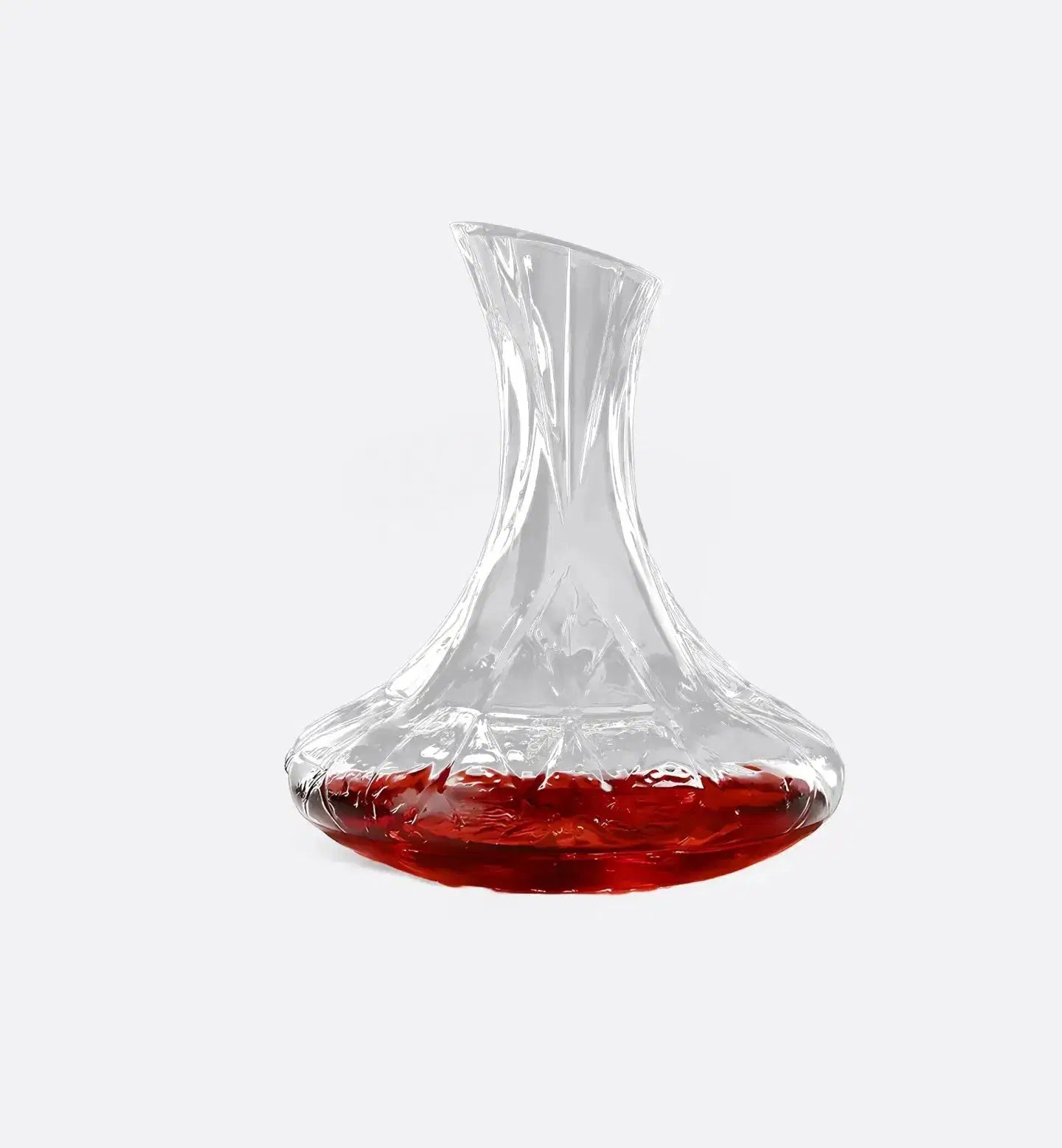
The Rays decanter fully embraces its artistic dimension. Its pattern of horizontal ridges carved into the blown glass captures and refracts light into a multitude of shifting reflections depending on the viewing angle, transforming each serving into a visual spectacle. Its slightly inclined neck is not just an aesthetic flourish: it facilitates pouring by naturally directing the flow of wine towards the rim of the glass, for a clean and precise serve. With its 1.8 L capacity, the Rays comfortably accommodates tannic reds and oxidative whites. Its unique surface texture also makes it an unforgettable oenophile gift idea for lovers of beautiful glass and contemporary design.
Which decanter matches your tasting profile?
Choosing your decanter also means knowing yourself as a wine drinker. Here are four profiles and the models that best suit them.
You love young, tannic red wines — Bordeaux, Syrah from the northern Rhône, Barolo, Tannat — and you want to reveal them quickly without waiting for hours: the Silver Edition or the Aurora, with their rotating bases, are your allies. They cut the necessary aeration time in half compared to a classic decanter and transform the act of decanting into a spectacular gesture in front of your guests.
You host dinners and are looking for a wine decanter that enhances your table as much as it performs oenologically: the Eclipse in crystal and the Rays in blown glass are designed for this. They catch the eye, invite admiration, and serve the same way a beautifully presented dish elevates the tasting experience beyond the contents of the plate.
You are looking for a versatile decanter for daily use, which works just as well for a Rhône red consumed during the week as for a fine Burgundy on the weekend: the Solen is your obvious choice. Simple, effective, durable, and elegant enough not to look out of place on any table, it is our reference recommendation for beginners or to replace a worn decanter. To deepen your wine knowledge and better choose your accompanying glasses, our guide How to choose the right wine glass usefully complements this article.
You often entertain and serve standing up, in cocktail party or buffet mode, with levels to maintain in several decanters simultaneously: the Veloce, thanks to its integrated handle, helps you avoid mishaps and allows you to serve precisely even in the most lively conditions. Complete your equipment by discovering our full range of matching wine glasses for a perfectly coordinated service.
Expert tips for using your decanter
Owning a beautiful decanter is not enough: you still need to use it in the right conditions to get the full benefit. Here are some practical benchmarks, summarized from the recommendations of professional sommeliers and the guides of French wine institutions.
Regarding decanting time, the general rule is as follows: a young, vigorous red wine (less than five years old, woody notes, and lively tannins) benefits from 30 to 60 minutes of aeration. A cellar-aged wine from 8 to 15 years generally opens up in 20 to 30 minutes in a wide-bottomed decanter — longer than this and it risks losing its freshness. Very tannic and very closed grand crus can benefit from one to two hours in a rotating model. Powerful barrel-aged white wines (great Burgundies, Roussanne) appreciate 15 to 20 minutes of aeration, but keep the decanter cool to avoid warming the wine.
Regarding temperature, make sure your wine is at the correct serving temperature before decanting: a red served too cold will release fewer aromas even after aeration. Decanting can slightly warm the wine — about one degree per 15-minute interval depending on the room's ambient temperature — which should be anticipated by decanting the wine slightly below its ideal serving temperature.
For cleaning, rinse immediately after use with lukewarm water without detergent to prevent tannin deposits that stain the glass. For deep cleaning, stainless steel cleaning beads work wonders without risking scratching the inner wall. Our complete care guide details all techniques by decanter type and deposit.
FAQ — Frequently Asked Questions about Decanters
Discover our wine decanters
Expertly selected by our team — Gustave Montclair catalog

Exclusive reader offer
−10% off the entire catalog
Valid on all our decanters, glasses, and accessories.
Sources
- OIV — International Organisation of Vine and Wine, technical tasting guides — oiv.int — 2024
- BIVB — Bureau Interprofessionnel des Vins de Bourgogne, consumer guide to decanting — bivb.com — 2023
- CIVB — Conseil Interprofessionnel du Vin de Bordeaux, technical sheets for service and aeration — bordeaux.com — 2023


