


Wine Decanter: How to choose the right one
Shape, capacity, material — everything you need to know to select the wine decanter that will reveal each of your vintages.
Choosing a wine decanter is a decision that will profoundly transform your tasting experience. More than just a serving accessory, the wine decanter – or wine aerator – is the ultimate oenological tool: it oxygenates the wine, releases its aromas, and refines its tannins even before the first glass is poured. However, with the diversity of models available, the choice can seem complex. Which shape to prefer? Which capacity to adopt? Glass or crystal? This comprehensive guide answers all these questions, with concrete recommendations from our expertise in tableware.
At Gustave Montclair, we design each wine decanter with both oenological efficiency and visual elegance in mind. Our models are designed to naturally integrate into a refined table, alongside matching wine glasses that will complete the tasting experience. Before diving into the selection criteria, let's start by understanding why decanting a wine truly changes the tasting experience.
Why use a wine decanter: the benefits of decantation
Decantation is a practice inherited from centuries of oenology. Originally, it primarily served to separate the wine from its solid deposits – the precipitated tannins found in aged red wines. Today, the wine decanter fulfills a dual mission: eliminating these deposits when present, and more generally aerating the wine to reveal its full aromatic potential.
Oxygenation plays a crucial role in the expression of a wine. When a young, tannic, and closed red wine comes into contact with air via a wide-based decanter, a chemical reaction begins: the tannins soften, fruity notes emerge, and vegetal or reductive aromas that could mask the bouquet gradually fade away. A harsh Bordeaux served directly from the bottle can thus be transformed after thirty minutes in a suitable wine aerator. To learn more about the precise mechanisms of this phenomenon, our article on decantation versus aeration will provide all the keys.
Beyond chemistry, the wine decanter transforms service into a ritual. Presenting a beautiful wine decanter on your table signifies to your guests that you have taken care of their experience. It is a refined gesture of hospitality, elevating the meal to the level of a true wine ceremony. It's no coincidence that gourmet restaurants systematically place wine in a decanter when serving a great vintage: the object itself carries a message.

Shape, capacity, material: essential criteria for choosing your wine decanter
There is no universal wine decanter — each parameter influences the result in the glass. Here are the three fundamental dimensions to evaluate before your purchase.
The shape: the key to aeration
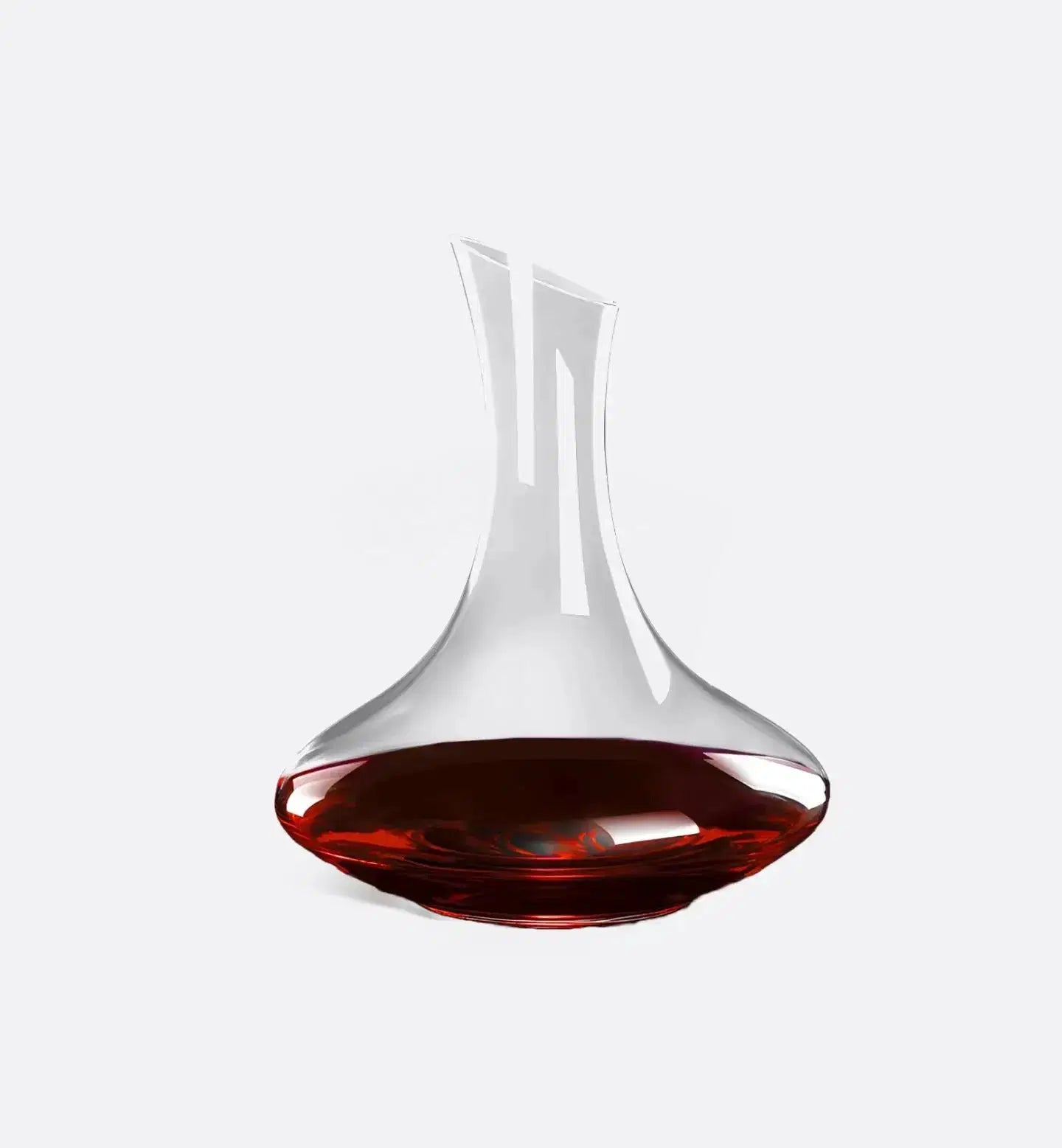
The shape of a wine decanter directly determines the contact surface between the wine and the air. The wider this surface, the more intense and rapid the aeration. This is why decanters with a flared base — like our Solen model with its large rounded belly — are perfect for powerful, young red wines that require sustained oxygenation. Conversely, a narrower decanter, like the slender Ligna model, offers softer aeration, ideal for delicate wines or older vintages whose aromatic complexity you wish to preserve.
The neck of the decanter also plays a practical role: a wide neck facilitates pouring and cleaning, while a thinner neck allows precise control of the flow during service. For beginners, we recommend favoring wide necks which simplify maintenance — a criterion often underestimated at the time of purchase. Our guide on how to choose your wine glasses also discusses how the morphology of the container always influences the tasting.
Capacity: adapting the decanter to your use
The vast majority of wine decanters on the market range from 1.2 L to 1.8 L, which corresponds to a standard 75 cl bottle with a comfortable aeration margin. Our Gustave Montclair models unanimously adopt a capacity of 1.8 L, designed so that the wine can unfold without being constrained. Certain specific models, such as our Éra or our Veloce, maintain this standard while offering very different silhouettes to adapt to all table aesthetics.
If you regularly entertain a large number of guests, or if you want to decant two bottles simultaneously during a dinner, capacities from 2 L to 3 L also exist. However, for daily or semi-regular use, 1.5 to 1.8 L remains the most versatile and elegant format to handle.
The material: glass or crystal?
The question of material is often the one that generates the most debate among wine lovers. Blown glass offers satisfactory solidity, appreciable lightness, and transparency allowing appreciation of the wine's color. This is the choice we have favored for our entire collection of wine decanters: our quality glass models offer remarkable optical transmission and resistance suitable for regular use. Lead-free crystal, on the other hand, provides superior clarity and lightness, with a characteristic crystalline sound — qualities you will find in our crystal decanters versus glass decanters. For daily use, superior quality glass is often the most pragmatic choice. For gifting, crystal is a natural choice.
| Model | Capacity | Shape | Ideal for | Rating |
|---|---|---|---|---|
| Solen | 1.8 L | Wide rounded base | Powerful reds, young wines | ★★★★★ |
| Ligna | 1.8 L | Slender, minimalist profile | Delicate reds, white wines | ★★★★★ |
| Éra | 1.8 L | Balanced ovoid shape | Versatile use for red and white | ★★★★★ |
| Néora | 1.8 L | Tapered silhouette | Contemporary table, gifts | ★★★★★ |
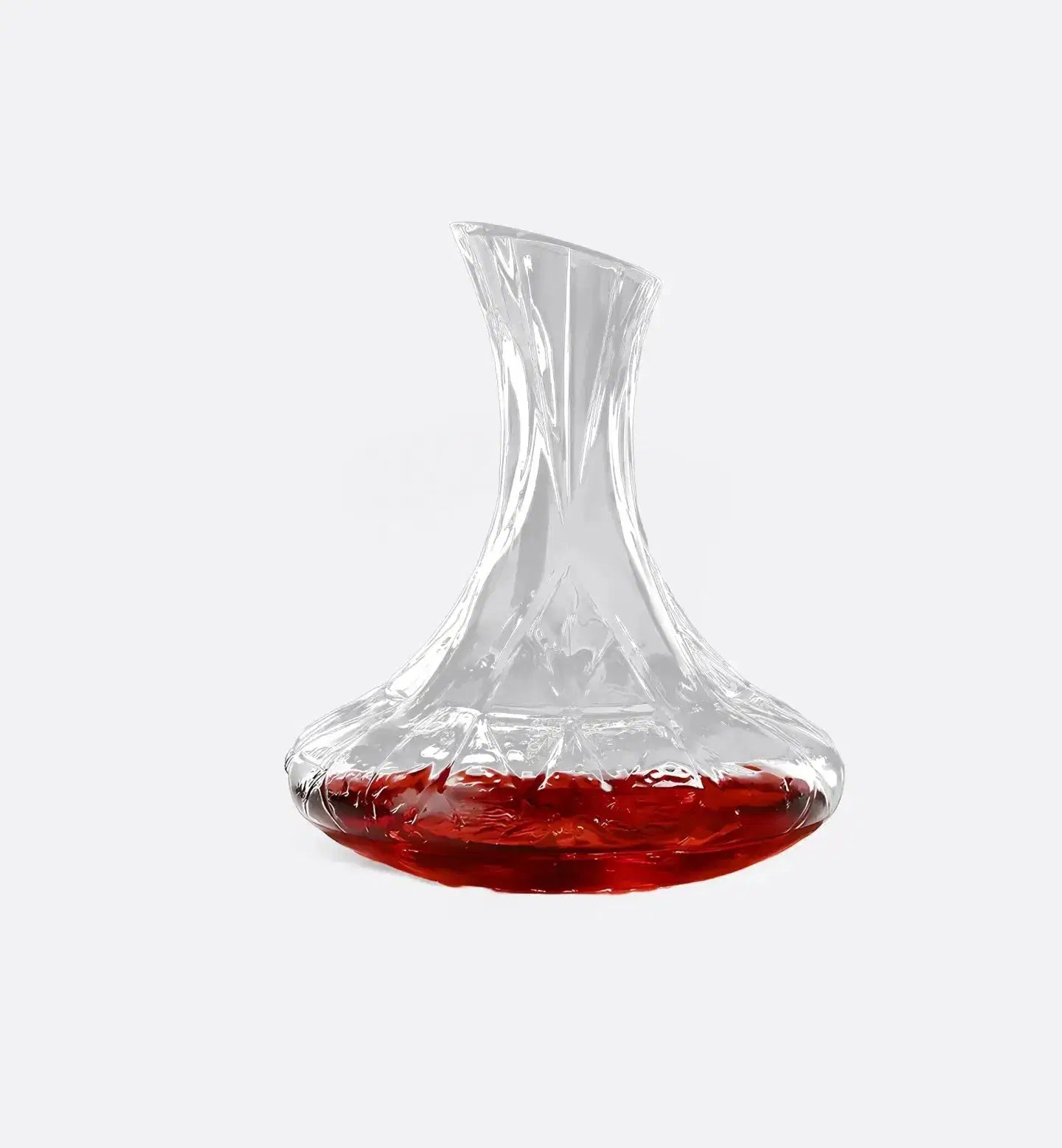
| Rays | 1.8 L | Geometric facets | Highlighting grand crus | ★★★★★ |
| Veloce | 1.8 L | Aerodynamic profile | Modern table design | ★★★★★ |
Red wines, white wines, old wines: which wine decanter for each situation?
One of the most common misunderstandings among wine lovers is thinking that a wine decanter is only for reds. In reality, many white wines – especially great Burgundies, barrel-aged Viogniers, or Roussanne – benefit from a light aeration of ten to fifteen minutes before serving. For these wines, a narrow-necked decanter is more than sufficient: the goal is to open up the aromas without diluting them in too large an air surface.
For young, tannic red wines – Cahors, Madiran, Barolo, Cabernet Sauvignon under five years old – decanting in a wine aerator is almost essential. Allow between thirty minutes and two hours depending on the wine's power. A decanter with a very wide base, like our Solen or Veloce, will maximize oxygenation. For older wines, however, caution is advised: a great aged vintage can quickly close up once exposed to air. A short decantation, twenty to thirty minutes, in a standard-sized decanter, will yield the best results.

Rosés and sparkling wines, on the other hand, are generally not decanted: the decanter would cause rosés to lose their aromatic freshness and champagnes their bubbles. If you are looking to enhance a champagne or a lively white wine, our flutes and champagne glasses are specifically designed to preserve tension and effervescence. For distilled spirits, our whiskey decanters offer an equally refined complementary universe.
Rotating decanter and aerator: trends revolutionizing tasting
Innovation in the world of the wine decanter has not stopped at classic shapes. In recent years, rotating decanters have emerged as a particularly effective alternative for those in a hurry or those who want precise control over aeration. The principle is simple but ingenious: by swirling the wine in a double-walled or inclined-bottom decanter, the contact surface with the air is multiplied in just a few seconds — whereas a classic decanter sometimes requires an hour of waiting.
Our Aurora model, the flagship rotating wine decanter in our range, embodies this revolution. Designed to decant in a quarter of the time of a traditional decanter, it combines a sculptural silhouette with stunning functionality. Its pivoting base allows for a natural swirling motion that instantly enriches the wine with oxygen. It is also one of our most popular items for Father's Day gift ideas: original, useful, and aesthetically remarkable, it impresses as much by its form as by its efficiency.
More generally, if you are hesitating between several models of wine aerators and want additional visual cues to guide your choice, our complete collection of wine decanters will allow you to compare silhouettes, capacities, and finishes at a glance.
Care, cleaning, and gift ideas for the wine decanter
A quality wine decanter does not require complicated maintenance, but a few simple rules considerably extend its lifespan and preserve the purity of the aromas. The golden rule: rinse immediately after use with lukewarm water, without detergent. Dish soap leaves residues that alter the aromas of the next wine. To dissolve tannins that deposit on the walls, an effective method is to pour coarse damp salt into the decanter, then gently swirl the abrasive mixture before rinsing thoroughly. Stainless steel cleaning beads are also very effective for reaching difficult areas in narrow-necked decanters.
Drying also deserves attention: avoid using a hand towel, which can leave fibers or introduce odors. Simply invert the decanter onto a specific stand, or use a decanter dryer, which keeps the decanter tilted so that air circulates freely. Never put crystal models in the dishwasher — high temperatures weaken the glass and create an opaque film that is difficult to remove.

As for gift ideas, the wine decanter proves to be a particularly appreciated gift for oenology enthusiasts. During the Father's Day period — from April to June — a beautiful decanter combined with a complete sommelier set (corkscrew, thermometer, drip ring) forms an irresistible combination for all wine-loving dads. For an even more complete gift, consider pairing it with an assortment of wine glasses: offering a cohesive set is always more impactful than disparate pieces. For spirit lovers, our whiskey gift sets and whiskey sets provide an equally refined alternative. And if you're looking to complete your home bar, check out our metal bottle holders and our bottle storage solutions — accessories that finalize a stylishly organized wine cellar.
FAQ — Frequently asked questions about wine decanters
Our Wine Decanters — Gustave Montclair Selection
Expertly selected by our team — Gustave Montclair catalog




Exclusive reader offer
10% off the entire catalog
Valid on all our carafes, glasses, and accessories.
Sources
- OIV — International Organisation of Vine and Wine — oiv.int — 2024. Recommendations on oenological aeration practices.
- BIVB — Burgundy Wine Board — bivb.com — 2023. Guide to serving and tasting Burgundy wines.
- Union de la Sommellerie Française — udsf.fr — 2024. Reference for table service practices.


