


Champagne Glass: Buying Guide & Selection of the Best Flutes
Choosing the right champagne flute changes everything: perlage, aromas, elegance on the table. Our complete guide helps you find the ideal glass.
A champagne glass is not just a simple crystal or glass container. It is the silent instrument that orchestrates the entire experience, from the first spiraling bubble to the delicate aroma of yeast and white flower that graces the nose. Choosing the right champagne flute — or coupe, depending on the use — is choosing to respect what Champagne winemakers have spent months, sometimes years, developing. At Gustave Montclair, we know better than anyone: the art of tableware begins with the right glass.
This comprehensive guide walks you through the process of buying a champagne glass that meets your expectations. We cover the science of perlage, the influence of shape on aromas, the differences between flute, coupe, and tulip, the technical criteria to watch out for, and finally, our selection of champagne flutes, among which you are sure to find the model that matches your table, your taste, and your guests.
Why the champagne glass transforms your tasting experience
The question may seem superfluous: why invest in a specific champagne glass when any glass can hold liquid? The answer lies in three words — perlage, aromas, presentation — and each of these elements is deeply influenced by the geometry of the container.
Perlage: precise physics
Champagne bubbles do not appear by chance. They form on microscopic nucleations — imperfections in the glass, cellulose fibers — and rise in trajectories determined by the shape of the vessel. A classic, slender champagne flute concentrates these nucleations on a restricted surface, which produces a tight, regular column of bubbles that rises slowly and prolongs the effervescence far beyond what an ordinary glass would allow. In contrast, in a wide-rimmed goblet, the bubbles disperse in all directions, release too quickly, and the champagne loses its sparkle in a few minutes. This is a difference you can literally observe with the naked eye, and feel in your mouth with every sip.
Aromatic expression: capturing the bouquet
Beyond the physics of bubbles, the shape of the champagne glass plays a decisive role in how aromas develop and reach your nose. An opening that is too wide disperses aromatic molecules before they have time to concentrate. An opening that is too narrow traps them and creates a compressed, nuanced bouquet. The ideal point of balance, sought after by the best glass designers, is a tulip shape that is slightly tapered in the middle and then opens upwards: the natural convection of the liquid first concentrates the aromas, before delicately releasing them upon inspiration. The result: you perceive the notes of brioche, yeast, white flowers, and white-fleshed fruits that characterize a great champagne, whereas an unsuitable glass would have masked them.
Aesthetics: elegance at the service of the moment
Grand occasions — weddings, New Year's Eve, birthdays — deserve careful staging. A beautiful champagne flute, placed on a carefully set table, becomes a strong visual signal: that the host values their guests, and has thought of every detail. Conversely, serving a great vintage in a mismatched or flared glass sends a different message. The champagne glass is, in this sense, an instrument of courtesy as much as a tasting tool. If you are interested in the art of enhancing your wines when serving, our article on how to choose the right wine glass explores these same principles for red and white wines.

Flute, coupe or tulip: which shape to choose?
The market offers three main families of champagne glasses, each with its own qualities and optimal uses. Understanding their differences will allow you to buy exactly what you need — whether you are a passionate amateur, a catering professional, or simply someone who likes their table to be beautiful.
The champagne flute: the timeless reference
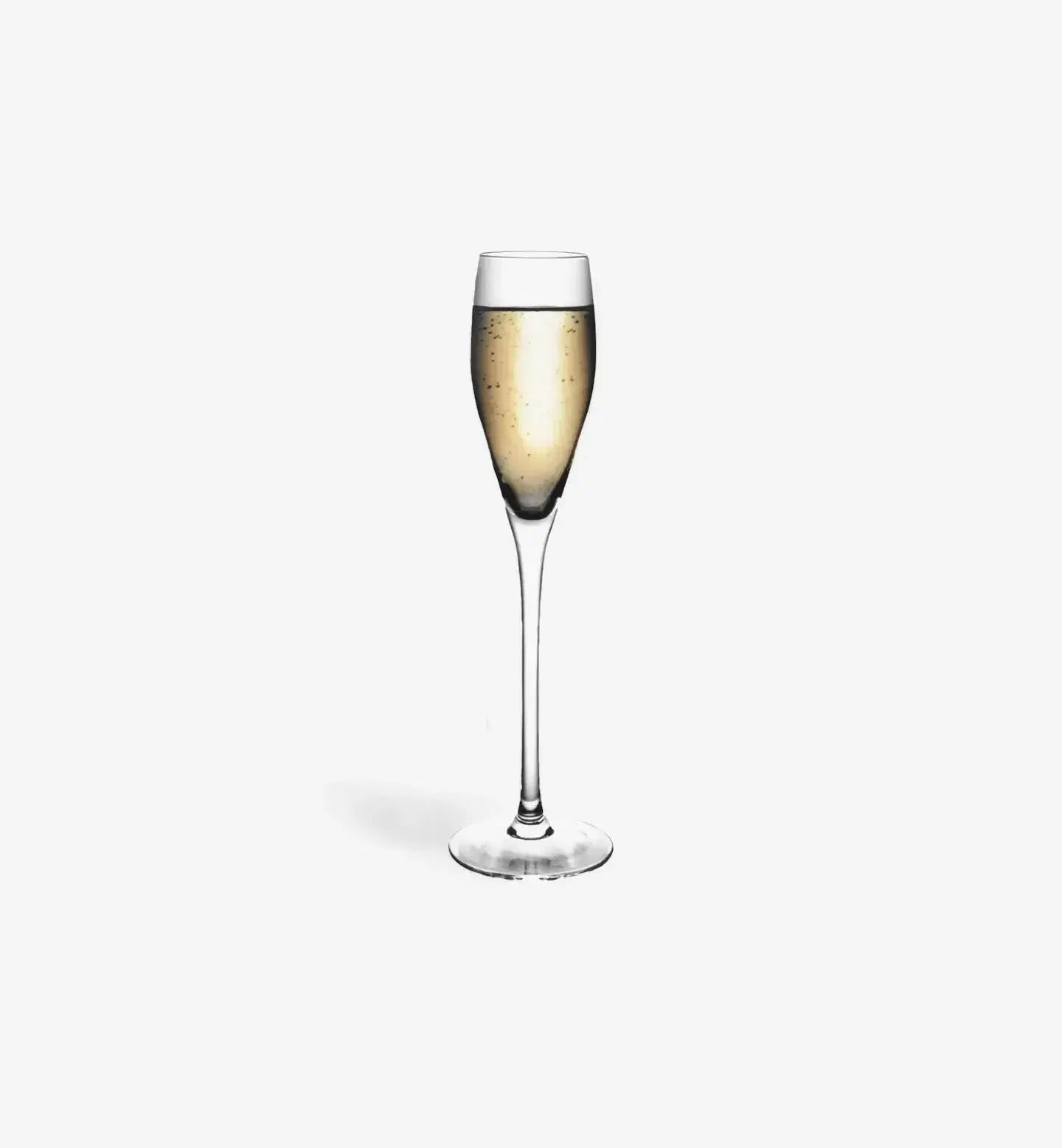
The champagne flute is the most common model, and for good reason: its elongated silhouette, slender stem, and moderate opening make it the reference glass for the vast majority of champagnes. It preserves effervescence for a long time, concentrates aromas with precision, and naturally stands as a symbol of celebration and elegance. It is available in a range of capacities, generally from 150 to 250 ml, allowing for ample serving without the champagne warming up.
For high-quality champagne flutes, Gustave Montclair's design office has worked on precise opening angles and calculated wall thicknesses to maximize the duration of the perlage. Our champagne flutes combine these technical criteria with contemporary designs that make each model a collector's item.
The champagne coupe: grand decor
The champagne coupe evokes the grand tables of the 19th century and Belle Époque soirées. Its flared shape is magnificent, visually spectacular, and ideal for creating champagne fountains at receptions. However, its wide opening promotes the rapid dispersion of bubbles and the evaporation of aromas, making it less suitable for serious tasting. It remains, however, a strong aesthetic choice for grand occasions where ceremonial takes precedence over sensory precision.
The tulip: the best of both worlds
The tulip is a synthesis: wider than the flute at the bowl, it promotes better aromatic expression while remaining tall enough to maintain the perlage. Oenologists and sommeliers increasingly favor it for prestige champagnes and complex sparkling wines, as it captures aromatic nuances that the simple flute can compress. If you want a versatile glass — for champagne, crémant, or natural sparkling wine — the tulip is often the best investment.
| Shape | Perlage | Aromas | Ideal for | Our opinion |
|---|---|---|---|---|
| Champagne flute | ★★★★★ | ★★★★☆ | Appetizer, toast, celebration | Recommended |
| Tulip | ★★★★☆ | ★★★★★ | Tasting, grand vintages | Expert |
| Champagne coupe | ★★☆☆☆ | ★★☆☆☆ | Fountains, decoration, receptions | Ceremonial |
| Universal glass | ★★☆☆☆ | ★★★☆☆ | Informal daily use | Troubleshooting |
Essential criteria for choosing a champagne glass
Beyond the shape, several technical criteria determine the quality of a champagne glass and justify investing in a carefully crafted model rather than a mass-produced one.
Capacity: neither too much, nor too little
The ideal capacity for a champagne glass is between 150 and 250 ml. Below this, serving is too frequent and the champagne lacks space to express its bubbles. Above this, the risk of warming is real, especially if the glass remains in the hands of a chatty guest for too long. A capacity of 200 ml represents the balance point we recommend for most domestic uses.
Glass fineness: a matter of sensation
The fineness of the glass wall often plays an underestimated role. A thick rim creates a physical barrier between the liquid and your lips, and a rough sensation that contrasts with the delicacy of champagne. A fine rim, conversely, almost disappears during tasting, allowing the wine to express itself fully. This is why quality glasses — like our collection of champagne glasses — are blown with thin, carefully calibrated walls.
Stem height: stability and hold
The stem of a champagne flute is not just an aesthetic element. It must be high enough to allow for an elegant grip without the heat of the hand rising to the bowl of the glass — which would prematurely warm the champagne and accelerate the dispersion of bubbles. A stem of 7 to 10 cm is generally the norm for quality champagne flutes.
Design: the visual identity of your table
Finally, design is a matter of consistency. Your champagne glass should harmonize with the visual universe of your table. Gustave Montclair's champagne glasses have been designed for this consistency: clean or subtly sculpted lines that perfectly match both a contemporary table and a classic setting. They naturally pair with our wine glasses and can complete a sommelier set for a prestigious table.
Our selection of Gustave Montclair champagne flutes
Our collection of champagne flutes is designed to meet all profiles — from demanding connoisseurs to hosts mindful of aesthetics, as well as those looking for a memorable gift for a wedding, birthday, or Father's Day. Each model has been meticulously crafted with attention to shape, fineness, and visual balance. Here are the three models we recommend most highly.
Crown: the flute that crowns your table
The Crown champagne glass (165 ml) stands out for its unique shape: a slightly flared profile towards the top that recalls the silhouette of a crown. This design detail is not insignificant — it promotes a slight aromatic opening while maintaining a regular rise of bubbles. Its 165 ml capacity is ideal for aperitif bubbles, toasts, and brief celebratory moments. On a table, this glass immediately creates a strong visual effect, and its slender stem gives it the elegance that characterizes grand tables. An excellent choice to buy a champagne glass intended as an original gift or to refresh your set.
Classic II Color: timeless elegance with a touch of character
The Classic II Color champagne glass (200 ml) embodies classic sobriety brought to perfection. Its straight and slender silhouette, characteristic of traditional champagne flutes, is here enhanced by a subtly colored stem — available in several shades — which adds a touch of character without ever being ostentatious. With its 200 ml capacity, it perfectly matches our recommendation for balanced service. This is the model we recommend for dinner tables, weddings, or any event where you want to combine tradition and attention to detail.
Sun: the flute that catches the light
The Sun champagne glass (150 ml) plays on a simple but striking principle: its lightly structured surface captures ambient light and reflects it in a thousand golden hues, visually enhancing the champagne's color. At 150 ml, it is a champagne flute designed for short, intense moments — a welcome drink, a midnight toast, a quick tasting. Its contemporary design fits equally well in an intimate setting or at a large reception. For lovers of beauty and the unusual, the Sun is a piece that leaves a lasting impression.
Care, pairings and gift ideas
Caring for your champagne flutes
A quality champagne glass is earned and preserved. Hand washing remains the recommended method: lukewarm water, a mild detergent, careful rinsing with clear water, and gentle drying with a microfiber cloth. If you opt for the dishwasher, use only a delicate program at low temperature (maximum 45°C) and avoid overly aggressive detergents that dull the walls and weaken the stems. Store your champagne flutes upright, never upside down on a hard surface that could mark the rim.
Pairing your flutes with a complete set
A beautiful table is built in layers. Your champagne glasses are best paired with wine glasses from the same line for perfect visual consistency. If you are hosting spirits enthusiasts, our whisky glasses ideally complement the service for digestifs. For festive occasions that mix wines, bubbles, and cocktails, also consider our collection of cocktail glasses, which offer designs as refined as our flutes. If you want to understand the links between aeration and aromatic expression, our article on wine decanting and aeration will give you valuable insights.
Giving a champagne flute: the best occasions
A champagne flute is one of the most universal gifts there is. It transcends ages, tastes, and lifestyles with unmatched grace. For a wedding, offering a set of six champagne glasses is a gift that is both practical, memorable, and symbolic. For Father's Day or a birthday, a pair of flutes accompanied by a whisky set or a complete sommelier set makes an original and refined gift idea. For those who want to discover the art of wine service, our article on crystal carafe vs. glass carafe offers additional suggestions. The wine carafe paired with a set of flutes forms a complete and coherent table gift, which we recommend for major events.
FAQ — Frequently Asked Questions about Champagne Glasses
Our Champagne Flutes — Gustave Montclair Selection
Expertly selected by our team — Gustave Montclair catalog


Exclusive reader offer
10% off the entire catalog
Valid on all our glasses, carafes, and accessories.
Sources
- Comité Champagne — Official guide to tasting and containers — champagne.fr — 2024
- BIVB (Bureau Interprofessionnel des Vins de Bourgogne) — The influence of the glass on aromatic expression — bivb.com — 2023
- Union de la Sommellerie Française — Service equipment recommendations — umf-france.com — 2024


